







Encorporation
Southeastern transformations as objects, subjects, and principles of study
How are the world and our methods to encounter it bound to each other?
Until relatively recently, western academic Zeitgeist strove to render this kind of question obsolete: „The“ scientific method, it went, is about delivering objective facts about the world, the researcher should behave as an outside, neutral, rational observer. His (yes, mostly his!) work provides us with insights into the very mechanisms of the world’s functioning, necessary to make prognoses and to model reality to humankind’s best use. Politics is to govern. Arts is to draw a picture, to make a sculpture. Architecture is to plan houses. Everything had become a function, a „to“.
Interestingly, this kind of rampant positivism seems to be especially endurable in the social sciences, and particularly in my discipline, political sciences. (western) Mathematics know latest since Gödel, physics since the emergence of quantum physics, that human being and knowing are inescapably situated within the reality they study, with all the limitations, the tensions, the undecidabilities that come with that epistemological realization. (especially eastern) Philosophy knew all along. Poststructuralists set up a whole subculture around decomposing the allegedly objective and rational securities their realist coevals purported. Even if any single truth exists, we, human beings, are not capable of observing it objectively – which is quite extensively proven by neuroscience, ironically.[1] Everything we know is shaped by subjective experience, context, culture, and perception. Every piece of knowledge shared not only influences the reality it describes, but also shapes the experiences and perceptions of those who receive it, altering the way they understand and engage with the world. The world, as it appears to us, is inevitably contradictory in its essence – either incomprehensible or incomplete, each perception stimulus indissociably interwoven with the cultural, social, experiential imaginations necessary for its conceptualization, for thinking about, speaking, for making sense of it.
This is hurtfully true also for the „to“- society, and its epistemological endeavor of shaping and evaluating each and every thing according to its function, as directed towards a scope. This methodological approach, by its very nature, prevents the study of transformation and change from engaging with the underlying real-existing processes and their complexities and dynamics. Instead, what is foremostly measured is the efficiency of movement towards a predefined telos. Objectivizing the study of function seems like a route of escape, denying the incomprehensibilities of an enlightened, intertwined, globalizing world. In the end, it was Gödel who paid a price for proving impossible Hilbert’s program of grounding all existent theories in mathematics to a finite, complete set of axioms. In the end, it was Fukuyama who became famous for declaring the „end of history“ after the collapse of the Soviet Union and the fall of the Iron Curtain in the early 1990s. In the end, we’d all like to hear a simple solution to all the manifold crises and problems and contradictions of our times.
Objectivizing the study of function however, making it superior towards other epistemologies, is also a power move, maybe a most basic one: proclaiming that „there is no alternative“. By objectifying societal transformation and the people involved, one assumes to already know the processes at play, as well as the motivations and goals of those involved. Ultimately, what then remains to be done is to assess, normatively, the progress that is being observed. The „objective observer“ is the one holding enough power to define the scope and judge the outcome. The conceptual logic behind such a move is one of ranking orders – as to be seen in the manifold indices providing an account of who is doing „best“ and „worst“ in terms of „human development“, „freedom“, „economic growth“, „democracy“, and so on and so forth.
***
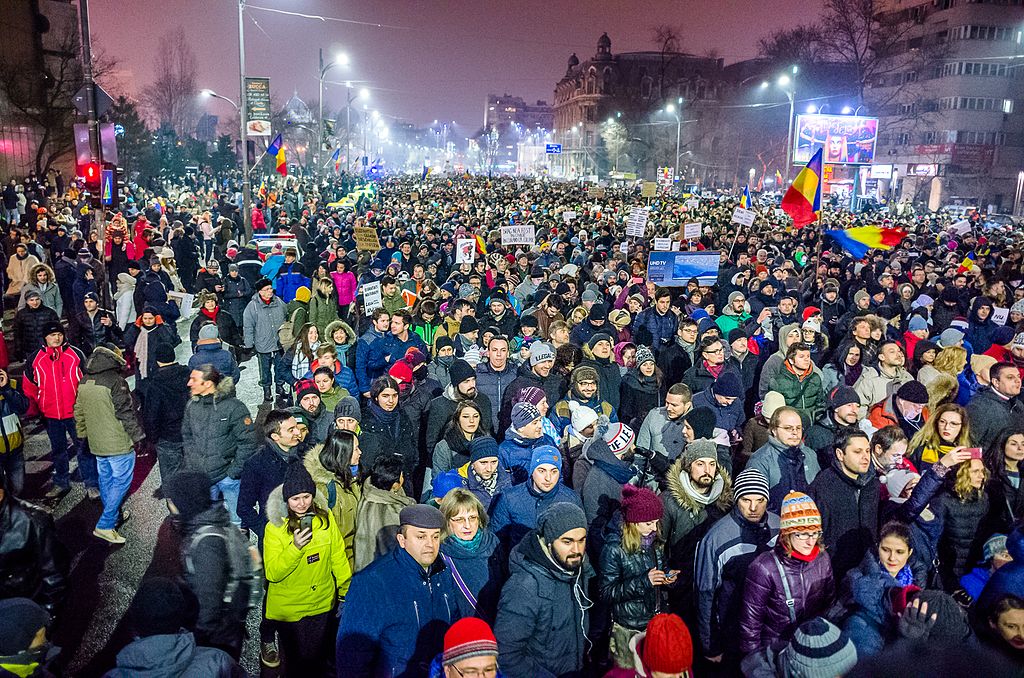 Protest against corruption – Bucharest, January 2017 – Piata Universitatii, photo Mihai Petre, wikimedia commons, https://commons.wikimedia.org/wiki/File:Protest_against_corruption_-_Bucharest_2017_-_Piata_Universitatii_-_5.jpg
When, in 2017, for once Romania appeared in German news media (apart from the customary announcements about „Gammelfleisch“ and „Sozialschmarotzer“), it was because hundreds of thousands of people had gathered in all the bigger cities of Romania and all the bigger centres of Romanian diaspora to protest. The „surprise“ about these events was characteristically condescending in voice: questions like „What’s up in Romania? What is happening? What do these people want?“ were asked mostly rethorically. Because the answers were already known. Because in the West, everything is already known about the East, by definition. Because it is the East that needs to „europeanize“, which doesn’t actually mean to become more European, but to become more German. And we already know what that is. Romanians, even after over 30 years of „catching up“, don’t. All that Romanians – a people with high degrees of mobility, multilinguality, living in a multicultural and multiethnic state in the middle of European history and geography – can want is more such „europeanization“. Which is foremostly to escape the world of post-socialist „legacy“: the apathetic society, the corrupt government. To become a „civilized country“. Accordingly, some Romanians finally woke up – most likely the young, white, well educated urban men, who likely studied „somewhere elsewhere“. The German newsmedia’s surprise about their awakening was condescending in that it was like patting a kid on their head for learning a thing a bit earlier than the adult thought they would. And it is easy to prove these answers, scientifically, when you know where to look for them. They are not wrong, by the way![2] Many Romanian protesters wove EU-flags, demanded better compliance to EU-standards, called Germany a more civilized country. And many of them came from the capital, are middle-aged men who studied, some also abroad.
However: Using EU symbols, writing adresses to European institutions, translating slogans to english and demands to western narratives etc. was in part also a strategy of Romanian adults to generate international attention. That is a different story. Another one is that East European political leaders welcome the anti-corruption discourse for being much easier derailed and put up against some individual opponent than discussions about political and economic contents. A yet different one is that protest doesn’t always show in street demonstrations, that protesters’ demographics, demands, and stances are much more diverse than the filters of publicity make it seem.
***
These stories will not be known by the researcher who tries to take herself out of the equation, who fears her own positionality, who strives to evade closeness, worrying to „distort“ her field of research by her presence in it.
And it is only one side of the problem that „we“, scientists, or „we“, the German public, don’t get to know these stories. The purist positivist approach (that believes its assumptions instead of handling them as presuppositions) also reiterates the distinction between world and ways of getting to know, and reproduces the hegemonic claim inherent in that.
So, where are the alternatives, how could we look at the world differently?
One alternative I want to propose is a logic of encorporation: of making the object of study simultaneously the subject of it.
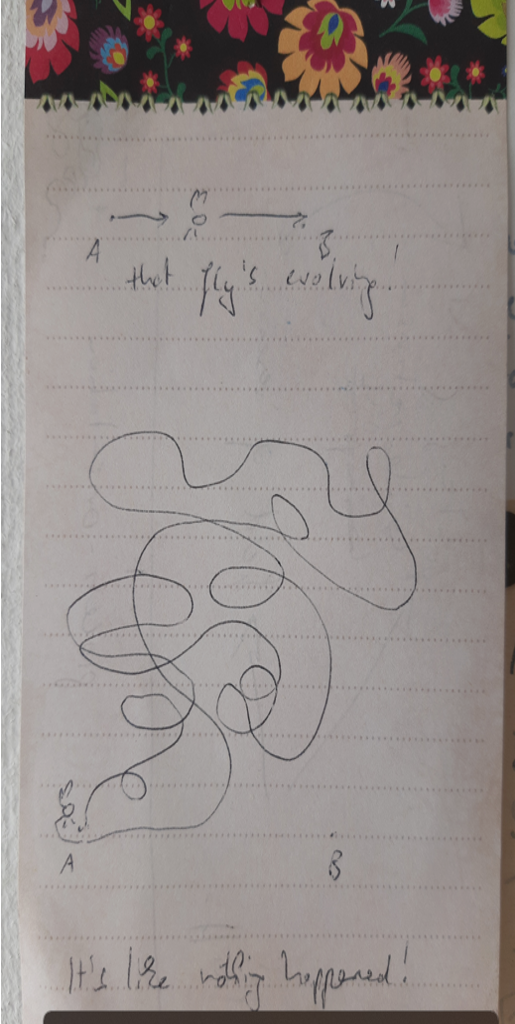
1) „that fly is evolving!“
2) „It’s like nothing happened!“
Author’s jot note
Instead of measuring inputs and outcomes, drawing straight lines between them, we can try to stick with the agents of our interest and see where they take us, and how, on which ways.
***
When coming to Tutzing in autumn 2023, I had thought about this idea, and its methodological implications, already for some time, with regard to my study of recent protest outbreaks in Romania and the interconnected shifts in Romanian political culture, and contentious politics in paticular. I had combined efforts with Romanian documentary filmer and self-denominated „political nerd“ Sergiu Zorger, to set up a living protest archive, online, a project we call „o altă poveste” – a different story, or another story. The idea is, instead of trying to pick the few dispersed pieces of the complex puzzle one person can individually see and carry, to create and facilitate a space for learning together. In which everyone interested could contribute. In which there would be space for contradiction, tension, and diversity, and that would be changeable – according to what users would contribute to it, and according to the feedback of the various activists we consulted for building the platform.
Somehow, in my head, terms had flipped already: When my university would call such collaborative digital projects „science communication“ – actually a code for „nice-to-have-stuff“ – and conceives of papers in peer reviewed journals as THE measurement of scientific productivity, I would put it the other way round: Science means doing collective learning, using my training, my time, and other resources for facilitating it, letting myself and my study be changed by my now subject of research. Writing papers remains important – whilst I would conceive of these papers as „science communication“ – communication with peers, mainly dedicated to theory building, methodology, and indications where to have another look at things.
In Tutzing, I loved to learn that this kind of study was not at all limited to scientific research, and that the encorporation-thought itself had passed through many minds before mine. I learned that „subjects“, or agents, are not always humans. Houses can be subjects. Histories and spaces can be. Also practices.
***
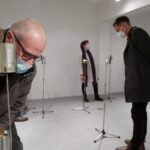
I learned how even the refusal to do something can be agentic in character: in his artictic intervention Antoni Rayshekov makes the silence of politicians the subject of his study. In „the evasive choir“[3] and „the evasive choir – remixed“[4] he creates a setting in which the story of Bulgarian post-socialist transformation is told through politicians’ refusal to talk about it, through the silence of those of all people who are assigned to decide, to take responsibility. The harrumphings and hawings translate the political dissonance to an acoustic one – loud silence, literally. The artist himself doesn’t „tell“ us anything. Instead, he uses his skill to display a tension, creating and facilitating a space for thinking, for associating and interpreting, leaving it open to the viewer to explore and add up to the study of that tension, and of the societal context it represents.
The arts in that is not an object, it is not engendered in the installations Rayshekov made. The tin cans used as speakers in the first version of the installation – Rayshekov claims that all of these were emptied by himself personally, during the Covid-pandemic – give (me) an association of ready-made, processed, all-the-same, maybe of resignation even. They position the artist towards his subject. As does, in the second version of the installation, the vintage record player, endlessly repeating the remixed sounds rhythmically.
What this repetitive, dull, mean for politics? What does it mean for transformation, for societal change? How does such post-socialist fragment compare to the socialist past? The installation made me think directly of the Romanian expression „wooden language“[5], describing the sometimes fascinating skill of communist politicians to use many words without saying anything. What did the people in Rayshekov’s installation say between the sounds they made? What did those sounds mean to them? What would they have said without them?
The work employs its subject also as a principle of action: it evades any clear statement itself. It repeats a processed „meal“, an already heard record, amplifying and intensifying the refusal, the evasion, the silence of its creators. They cannot speak, the artist cannot speak. The work questions transformation, contrasting its assumed dynamic, disruption, and hope, with a readymade reality of everyday dullness.
***
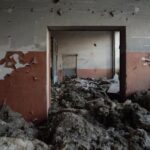
Another take on encorporation I found in Dragana Konstantinović’s and Miljana Zeković’s presentation on their architectural approach towards renovating socialist buildings in the city of Novi Sad.[6] Instead of understanding renovation as „repair“, as going back to an imagined „original state“, rendering the present dereliction a deviance from „normality“, they decided to take on the whole reality of a building’s lifetime, to bring its history over to a renewed state. Together with their students, Konstantinović and Zeković studied abandoned buildings in their city from the inside, using the state in which they found them as an inspiration for their drawings, fotographies, historical research, and, eventually, architectural work. They collected artefacts from abandoned houses, crafted artistic studies and drafts to catch their athmosphere, sometimes zooming in to levels of detail, traces of use, or sometimes zooming out to the building’s position in the urban landscape, its historical, social, cultural, political background. They studied shapes, incidences of light, colors and textures of the buildings. All these studies were used as starting points for a holistic and complex translation of the buildings’ multiple pasts, of their „wanted“ as well as „unwanted“ histories.
So, here again, an object becomes a subject of study: Konstantinović and Zeković used the buildings as a site for (self-)education, for research, for creativity. The investigation takes serious the multiple realities of the buildings-as-subjects, and let them change the approaches towards and outcomes of the renovations . This way, again, transformation becomes a principle of the study: architecture, in Konstantinović’s and Zeković’s approach, is not about making up something, about building a house. It is about transforming a space, and in displaying that transformation, making it visible, through that process. What in scientifical work oftentimes sounds as giving up oneself into the infinite play of meta-levels, I thought, becomes plastic, literally tangible, in the work of architects.
***
This notion reminds me again of the object, subject, and principle of my own discipline: the political. The political condition is a tensionate one. It marks the organization of collective life, in light of the contingency and undecidability of its innumerable alternative ways, but given a necessity to make decisions between them, and to legitimate these decisions. Politics does take real forms – even if its ontological condition seems incommensurable. We can study politics, but, I argue, we should never forget, even if it’s „unwanted“, and definitely uncomfortable, to also situate the study within the political: We should ask for the potential alternatives, we should consider tension, investigate conflict, diversity, contention. Deciding for one or another methodological approach is in itself always a political decision, as research, knowledge production, and information, touch upon the organization of collective life, and as there is no „objectively“ right way to do research. Which does never let anybody off the hook for legitimating their choices!
Antoni Rayshekov could just have told me and the other attendants of his presentation about the hums and haws of the politicians in his country, or about what, in his perception, there is not enough open discussion in the Bulgarian political public sphere. Dragana Konstantinović and Miljana Zeković could have repaired some buildings in Novi Sad, according to old pictures of their state after construction, or original achitectural sketches. I could have taken media articles, Facebook posts, or official documents as the sources for measuring protest activities in Romania. Sergiu could have filmed them with his camera. However, we all decided to immerse ourselves, and this way learned about the diversity and tensionate character of contention, made silence audible and intellegible, and history tangible and usable.
So, all of the crafts mentioned can use their skill and training, in specific ways, to study the world. All of them can take interest in transformation, as an object of their study. And/or they can make transformation a subject of their work, giving the world studied a place and a say in the study itself. And they can acknowledge transformation as a principle of action, thoughtfully positioning within the world studied, and taking on the own influence on it as a characteristic and potential of the study.
***
However, coming back to the start of this essay, thoughtfully: with all that has been said in mind, being part of the world we study, we must still acknowledge that, simultaneously, we are also inescapably different from it, and we do make statements about the world all the time. Whether it is for communication, for making decisions, for living together – we need shared images of the world. Research needs to be written down, arts objectified, houses built. Studying things only from within, we would miss out how they look like from the outside.
What I wanted to elaborate was not at all anything like the solution to the problems positivism poses. In a more agnostic sense, I hope this essay will be read as an invitation for those standing aside to try and immerse, to explore what it brings about to accept the multiplicity of world-images, and one’s own situatedness within them. Engaging with the works of different disciplines, crafts, and arts helped me to overcome the urge to escape complexity and contingency. Such excursions, I think, may spark the curiosity that is necessary to leave well-trodden trails, to risk being frowned at at the next „serious“ event in one’s area of work.
***
Actually, the most serious frownings sometimes may be the most urging signals for a culture’s need for a change: Having come past of fully developing their foundational questions and potentials, some disciplines might enter a state of being mostly occupied with affirming importance and righteousness, to their insides as well as to their outsides. Which could be an interesting subject of research in itself, by the way.
[1] For an impressively comprehensive (yet accessible for the interested non-neuroscientist) elaboration of that fact, check Robert Sapolsky’s „Behave. The Biology of Humans at Our Best and Worst“.
[2] The sarcastic tone of this paragrah stems from my frustration, as someone who grew up within the eclectic reality of post-socialist transformation, with the air of objectivity so many outside observers give to themselves and their simple explanations, with the ardently maintained rightfulness, the brute generalization carrying their ever-repeating (and sometimes self-fulfilling!) statements.
[3] See https://community.ulysses-network.eu/works/view/2960/
[4] Visit https://vimeo.com/871063161
[5] Originally „limbă de lemn”.
[6] They give an account of their methodological approach towards renovation here: https://www.researchgate.net/publication/374316735_Rethinking_Dissonant_Heritage_The_Unabsorbed_Modernisation_of_Novi_Sad, I also recommend visiting the website https://mismobaza.org/novi-sad-moderni-grad/, „Novi Sad-Modern City“ was a project both presenters collaborated in with the occasion of Novi Sad being European cultural capital, 2022.